High stroke rates
Optimised moving masses; rotating and oscillating masses are balanced at every stroke length; up to 1,050 strokes per minute on the 500 and 630 kN sizes with 1,000 mm tool space.
Since 198343 years serving Turkish industry

High-speed precision presses
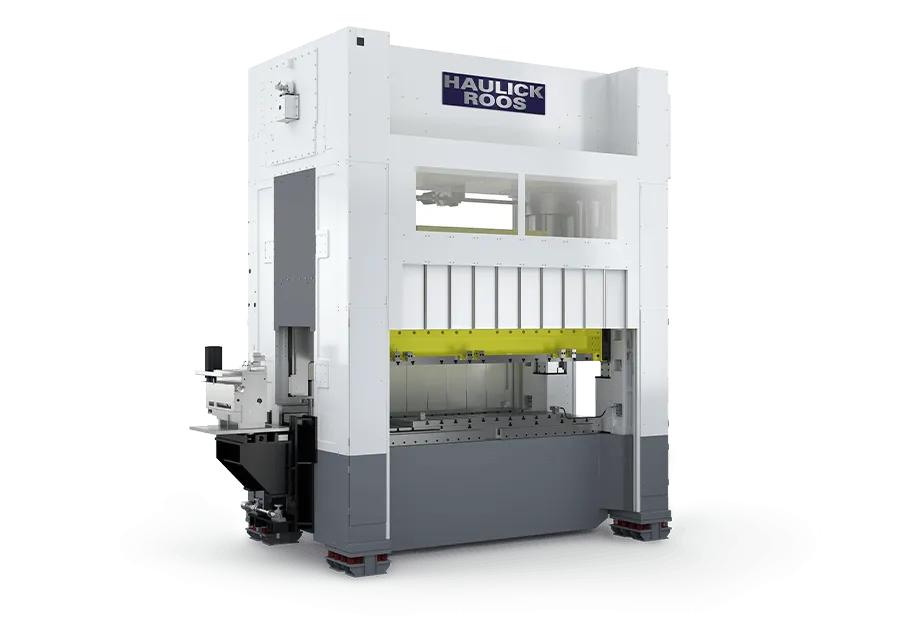
Precision high-speed stamping press with monoblock cast frame and full mass balancing
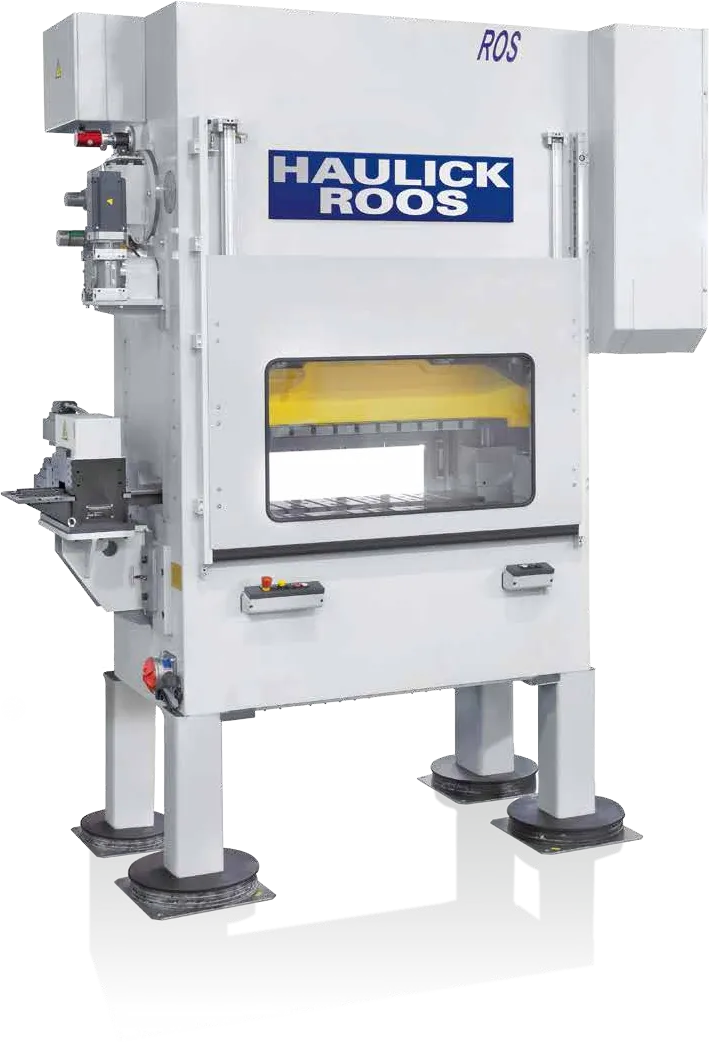
ⓘ Manufacturer data; Haulick + Roos ROS brochure and product page. Values may change and vary; not binding on Boztaş.
Optimised moving masses; rotating and oscillating masses are balanced at every stroke length; up to 1,050 strokes per minute on the 500 and 630 kN sizes with 1,000 mm tool space.
Monoblock frame in nodular cast iron, double connecting-rod drive with an eccentric shaft on four rolling bearings and wide con-rod spacing; KFS guide system and a slide guided to below the strip line.
Closed, large-volume oil circuit with cooling; the bolster serves as the oil tank; electric-motor slide adjustment; fine adjustment during operation and automatic stroke adjustment optional.
Tool space 1,000 or 1,250 mm; stroke 12–60 mm; 30–1,050 / 30–1,000 1/min; bolster depth 730 mm; 11,200–12,600 kg
Suited to: Stroke rates up to 1,050 1/min
Tool space 1,000, 1,250 or 1,600 mm; stroke 11–120 mm; 30–950 to 30–750 1/min; bolster depth 890 mm; 17,400–21,500 kg
Suited to: Tool space up to 1,600 mm
Tool space 1,250, 1,600 or 2,000 mm; stroke 12–120 mm; 30–750 to 30–500 1/min; bolster depth 1,100 mm; 28,400–38,500 kg
Suited to: Tool space up to 2,000 mm, 1,600 kN
Fixed-stroke design; no doors or panels in the tool area; vibration-sensitive components (encoder, motor etc.) on damped mounts; drive, feed and other units decoupled from the press; available on ROS and ROP with a close-fitting, safeguarded sound enclosure
Suited to: Parts with high cutting-shock load such as washers, chain link plates and rotor-stator laminations
| Feature | ROS 500 | ROS 630 | ROS 800 | ROS 1000 | ROS 1250 | ROS 1600 |
|---|---|---|---|---|---|---|
| Press | ||||||
| Nominal press force | 500 kN | 630 kN | 800 kN | 1,000 kN | 1,250 kN | 1,600 kN |
| Tool space, left to right (options) | 1,000 / 1,250 mm | 1,000 / 1,250 mm | 1,000 / 1,250 / 1,600 mm | 1,000 / 1,250 / 1,600 mm | 1,250 / 1,600 / 2,000 mm | 1,250 / 1,600 / 2,000 mm |
| Slide stroke, fixed (max.) | 60 mm | 60 mm | 120 mm | 120 mm | 120 mm | 120 mm |
| Slide stroke, adjustable | 12–60 mm | 12–60 mm | 11–120 mm | 11–120 mm | 12–120 mm | 12–120 mm |
| Slide adjustment | 60 mm | 60 mm | 80 mm | 80 mm | 100 mm | 100 mm |
| Speed | ||||||
| Stroke rate | 30–1,050 / 30–1,000 1/min | 30–1,050 / 30–1,000 1/min | 30–950 / 30–950 / 30–800 1/min | 30–900 / 30–800 / 30–750 1/min | 30–750 / 30–700 / 30–550 1/min | 30–700 / 30–650 / 30–500 1/min |
| Bolster and tool space | ||||||
| Max. die height (stroke down, adjustment up) | 320 mm | 320 mm | 360 mm | 360 mm | 420 mm | 420 mm |
| Bolster area (length × depth) | 1,000 × 730 / 1,250 × 730 mm | 1,000 × 730 / 1,250 × 730 mm | 1,000 × 890 / 1,250 × 890 / 1,600 × 890 mm | 1,000 × 890 / 1,250 × 890 / 1,600 × 890 mm | 1,250 × 1,100 / 1,600 × 1,100 / 2,000 × 1,100 mm | 1,250 × 1,100 / 1,600 × 1,100 / 2,000 × 1,100 mm |
| Slide clamping area (length × depth) | 1,000 × 450 / 1,250 × 450 mm | 1,000 × 450 / 1,250 × 450 mm | 1,000 × 550 / 1,250 × 550 / 1,600 × 550 mm | 1,000 × 550 / 1,250 × 550 / 1,600 × 550 mm | 1,250 × 700 / 1,600 × 700 / 2,000 × 700 mm | 1,250 × 700 / 1,600 × 700 / 2,000 × 700 mm |
| Passage between uprights | 310 mm | 310 mm | 415 mm | 415 mm | 505 mm | 505 mm |
| Bolster opening (length × depth) | 910 × 140 / 1,160 × 140 mm | 910 × 140 / 1,160 × 140 mm | 910 × 200 / 1,160 × 200 / 1,510 × 200 mm | 910 × 200 / 1,160 × 200 / 1,510 × 200 mm | 1,160 × 300 / 1,510 × 300 / 1,910 × 300 mm | 1,160 × 300 / 1,510 × 300 / 1,910 × 300 mm |
| Opening with split bolster plate, adjustable in depth | 40–140 mm | 40–140 mm | 60–220 mm | 60–220 mm | 120–300 mm | 120–300 mm |
| Bolster plate height | 100 mm | 100 mm | 125 mm | 125 mm | 150 mm | 150 mm |
| Design | ||||||
| Press frame | Monoblock, nodular cast iron (GJS) | Monoblock, nodular cast iron (GJS) | Monoblock, nodular cast iron (GJS) | Monoblock, nodular cast iron (GJS) | Monoblock, nodular cast iron (GJS) | Monoblock, nodular cast iron (GJS) |
| Drive train | Double connecting rod, eccentric shaft on 4 rolling bearings, full-complement roller con-rod bearings | Double connecting rod, eccentric shaft on 4 rolling bearings, full-complement roller con-rod bearings | Double connecting rod, eccentric shaft on 4 rolling bearings, full-complement roller con-rod bearings | Double connecting rod, eccentric shaft on 4 rolling bearings, full-complement roller con-rod bearings | Double connecting rod, eccentric shaft on 4 rolling bearings, full-complement roller con-rod bearings | Double connecting rod, eccentric shaft on 4 rolling bearings, full-complement roller con-rod bearings |
| Mass balancing | Rotating and oscillating masses (full balancing) | Rotating and oscillating masses (full balancing) | Rotating and oscillating masses (full balancing) | Rotating and oscillating masses (full balancing) | Rotating and oscillating masses (full balancing) | Rotating and oscillating masses (full balancing) |
| Guide system | KFS (slide guide + plunger guides in the frame); slide guided to below the strip line | KFS (slide guide + plunger guides in the frame); slide guided to below the strip line | KFS (slide guide + plunger guides in the frame); slide guided to below the strip line | KFS (slide guide + plunger guides in the frame); slide guided to below the strip line | KFS (slide guide + plunger guides in the frame); slide guided to below the strip line | KFS (slide guide + plunger guides in the frame); slide guided to below the strip line |
| Slide and stroke adjustment | Electric-motor slide adjustment; quick tool release and fine adjustment during operation, automatic stroke adjustment and hydraulic clamping of the adjusting spindle optional | Electric-motor slide adjustment; quick tool release and fine adjustment during operation, automatic stroke adjustment and hydraulic clamping of the adjusting spindle optional | Electric-motor slide adjustment; quick tool release and fine adjustment during operation, automatic stroke adjustment and hydraulic clamping of the adjusting spindle optional | Electric-motor slide adjustment; quick tool release and fine adjustment during operation, automatic stroke adjustment and hydraulic clamping of the adjusting spindle optional | Electric-motor slide adjustment; quick tool release and fine adjustment during operation, automatic stroke adjustment and hydraulic clamping of the adjusting spindle optional | Electric-motor slide adjustment; quick tool release and fine adjustment during operation, automatic stroke adjustment and hydraulic clamping of the adjusting spindle optional |
| Control | ||||||
| Control | PLC control; 15-inch colour touch display on an industrial PC; integrated process monitoring | PLC control; 15-inch colour touch display on an industrial PC; integrated process monitoring | PLC control; 15-inch colour touch display on an industrial PC; integrated process monitoring | PLC control; 15-inch colour touch display on an industrial PC; integrated process monitoring | PLC control; 15-inch colour touch display on an industrial PC; integrated process monitoring | PLC control; 15-inch colour touch display on an industrial PC; integrated process monitoring |
| Connections | ||||||
| Required air pressure | 6 bar | 6 bar | 6 bar | 6 bar | 6 bar | 6 bar |
| Dimensions and weight | ||||||
| Weight without feed (approx.) | 11,200 / 12,400 kg | 11,400 / 12,600 kg | 17,400 / 19,300 / 21,100 kg | 17,800 / 19,700 / 21,500 kg | 28,400 / 33,700 / 37,500 kg | 30,000 / 35,000 / 38,500 kg |
Manufacturer data; Haulick + Roos ROS brochure and product page. Multiple values are listed left to right by tool-space option (e.g. ROS 800: 1,000 / 1,250 / 1,600 mm). The model name gives force and tool space: ROS 1000-1600 = 1,000 kN, 1,600 mm. The manufacturer's general presentation gives its high-speed presses as 250–1,600 kN; the ROS brochure lists the 500–1,600 kN sizes. Technical changes reserved by the manufacturer.
Technical data is taken from information published by the manufacturer. The manufacturer may change it without notice, and values may vary with the model and the machine configuration. The data is for information only and is not binding on Boztaş; binding values are stated only in a written quotation.
Related industries: AutomotiveMachine BuildingElectricalElectronics and ConnectorsDomestic AppliancesMedical
The ROS is a high-speed stamping press: at the same size it reaches higher stroke rates (e.g. 500 kN with 1,000 mm tool space: ROS 30–1,050, ROP 30–400 1/min) and balances oscillating as well as rotating masses. The ROP is a precision stamping and forming press with an optional FSD servo drive; the ROS brochure lists no servo drive.
The tool space is 1,000 or 1,250 mm on the 500 and 630 kN sizes, 1,000, 1,250 or 1,600 mm on the 800 and 1,000 kN sizes, and 1,250, 1,600 or 2,000 mm on the 1,250 and 1,600 kN sizes. The stroke rate falls as the tool space grows (e.g. ROS 1600: 30–700 / 30–650 / 30–500 1/min).
For parts such as washers, chain link plates and rotor-stator laminations the manufacturer offers the RS package on the ROS and ROP series: fixed-stroke design, damped mounting of sensitive components, units decoupled from the press and a sound enclosure.
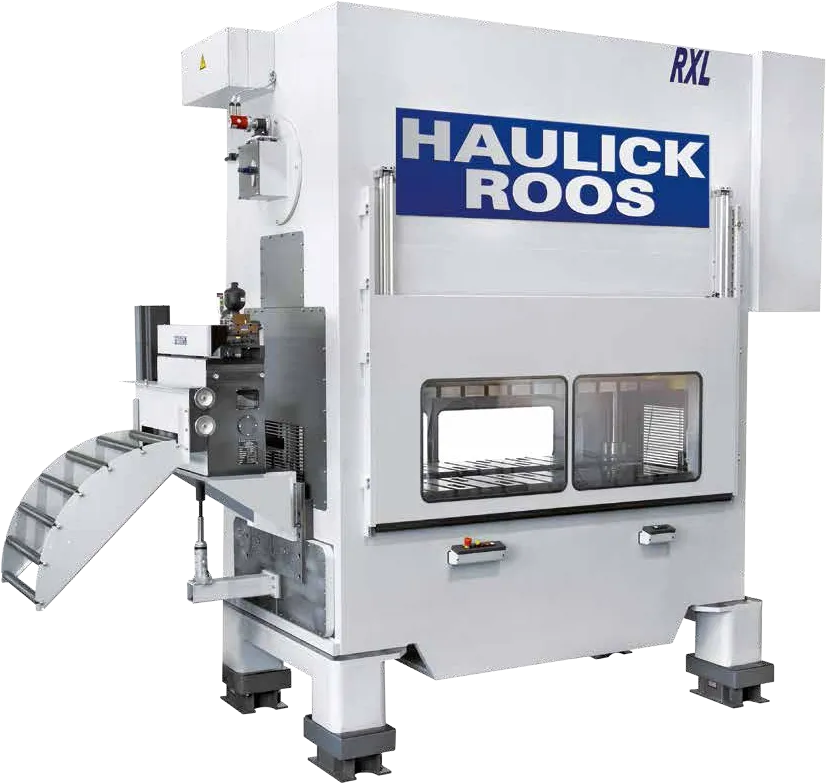 Haulick + Roos RXLneo 250–1,000 kN Precision stamping and forming press, the alternative to the ROP from 250 to 1,000 kN 250–1,000 kN760–1,600 mm Technical data
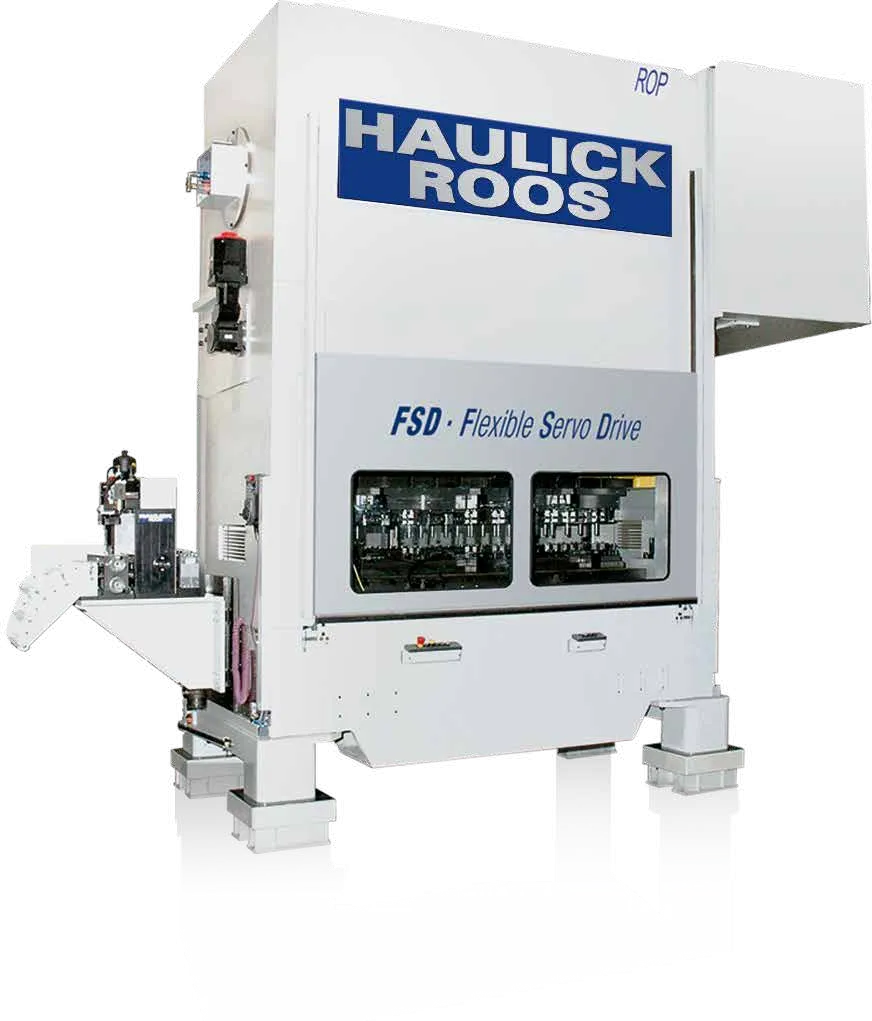 Haulick + Roos ROP 500–1,600 kN Precision stamping and forming press with KFS guide system and optional FSD servo drive 500–1,600 kN≤ 400 1/min1,000–2,000 mm Technical data
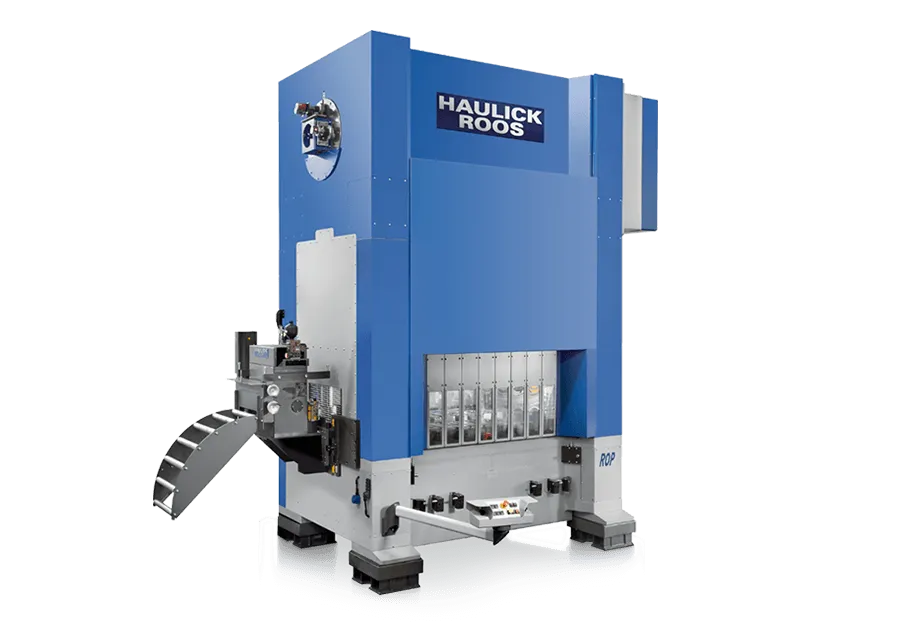 Haulick + Roos ROP 2,000–3,150 kN Large precision stamping and forming press with three-part cast frame, optional planetary gear and FSD servo drive 2,000–3,150 kN≤ 250 1/min1,600–3,000 mm Technical data
 Haulick + Roos ROP 4,000–5,000 kN Large precision stamping and forming press with up to 3,500 mm tool space, planetary gear or FSD servo drive 4,000–5,000 kN≤ 100 1/min2,500–3,500 mm Technical data